
Dryer Vent Cleaning Guide, IRC M1502 Duct Length & Fire Prevention
Restricted dryer exhaust vents trigger repeat thermal fuse blowouts, double cycle drying times, and rank as the leading ignition factor in residential USFA clothes-dryer fires. Under International Residential Code (IRC) Section M1502.4.5, smooth 4-inch rigid metal exhaust ducts are capped at 35 equivalent feet—deducting 5 feet for every 90-degree elbow and 2.5 feet for every 45-degree bend. Measure your layout below and inspect exterior roof or wall terminations before firing another heavy load.
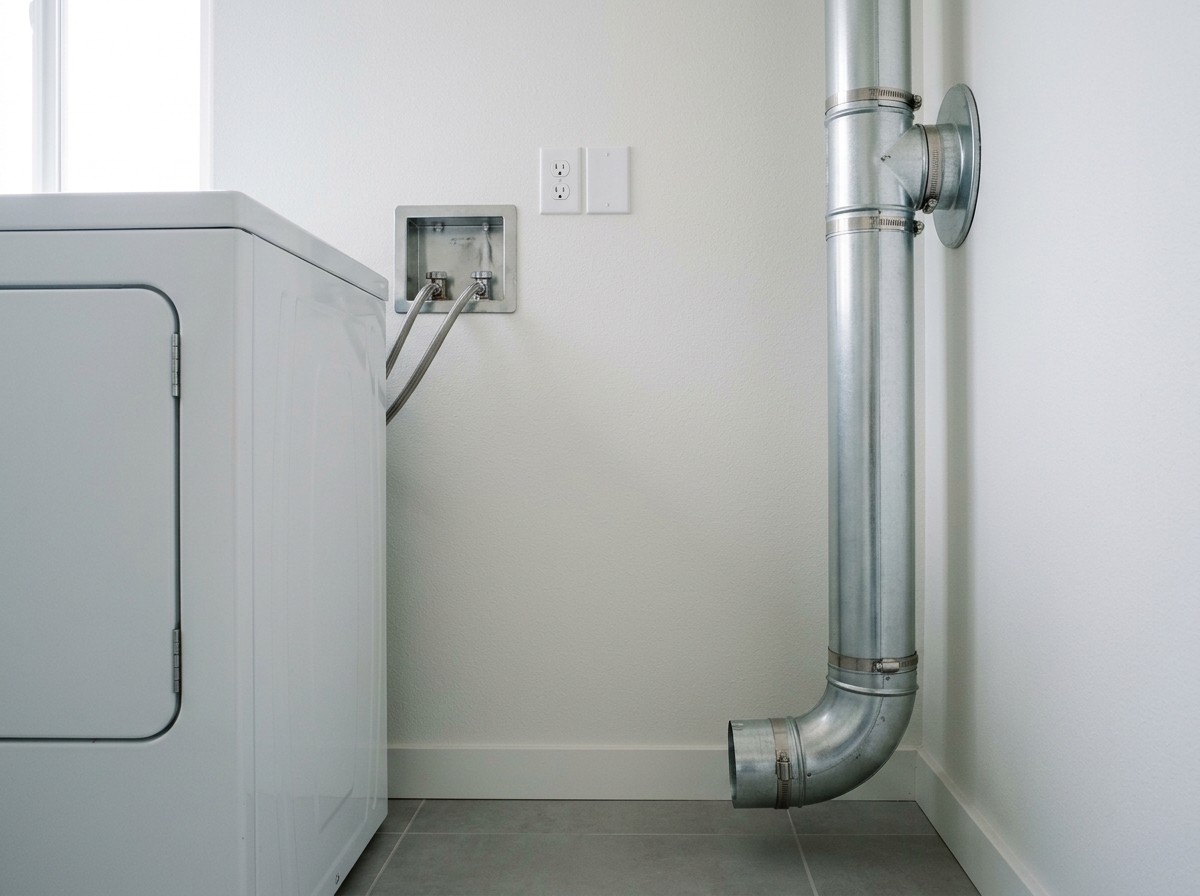
What building codes govern residential dryer vent sizing and runs?
IRC Section M1502 establishes strict smooth-wall duct diameters, elbow deductions, and unscreened termination dampers to keep lint moving freely outside.
- IRC Max Baseline Run
- 35 equivalent feet
- 90-Degree Elbow Penalty
- 5 ft per turn
- 45-Degree Bend Penalty
- 2.5 ft per turn
- Duct Diameter Spec
- 4 in rigid metal
- Termination Rule
- No screen backdraft damper
How does IRC M1502 calculate equivalent dryer vent length?
IRC Section M1502.4.5 caps rigid 4-inch dryer exhaust runs at 35 equivalent feet, subtracting 5 feet for every 90-degree elbow and 2.5 feet for every 45-degree turn. Calculate your home exhaust layout below.
How do duct bends reduce maximum safe dryer vent distance under IRC M1502?
Two tight 90-degree elbows behind a narrow laundry closet already consume 10 feet of effective static-pressure allowance before the pipe even enters the wall.
| 90-Deg Elbows | Deduction Penalty | Remaining Straight Pipe (35 ft Rule) | Inspection Priority |
|---|---|---|---|
| 0 Elbows (Straight wall) | 0 ft | Up to 35 ft | Annual lint brush check |
| 1 Elbow | 5 ft | Up to 30 ft | Check exterior flapper freely swings |
| 2 Elbows | 10 ft | Up to 25 ft | Swap foil transition for smooth rigid |
| 3 Elbows | 15 ft | Up to 20 ft | Inspect multi-floor chases for condensation |
| 4 Elbows | 20 ft | Up to 15 ft | Verify booster fan or ventless heat-pump |
Which five warning signs confirm a clogged dryer exhaust vent?
Catching static back-pressure early protects motor windings, preserves thermal fuses, and halts damp lint accumulation inside wall framing.
- Towel loads demand two full cycles: Moisture cannot exit saturated air pockets when exterior louvers barely crack open under exhaust pressure.
- Dryer cabinet top gets hot to the touch: Radiant heat buildup signals trapped plenum air shortly before thermal cutoffs blow open at >190 F.
- Musty smell or condensation on laundry walls: Disconnected joints in crawlspaces or attics dump hot humid lint onto floor joists and electrical boxes.
- Window screen traps behind exterior wall hood: IRC M1502 prohibits bird screens over dryer vents because damp lint weaves an airtight mat across wire mesh in weeks.
- D80 / d90 / FlowSense panel warnings: Modern LG, Whirlpool, and Samsung dryers flash 80%–90% flow-blockage codes before thermal shutdown triggers.
Who should choose DIY diagnostics vs hiring a licensed specialist?
Match DIY exterior rotary brushing against professional roof-termination clearing or duct re-routing. Compare statutory rules, regional BLS trade wages, and mechanical hazard boundaries carefully before commissioning repairs.
Ideal for ground-floor exterior walls with short straight ducts under 15 equivalent feet and zero recessed wall elbows.
Avoid when: Using flexible fiberglass rods that disconnect and trap brush heads inside 90-degree attic elbows.
Fits second-story soffits, steep pitched roof caps, long basement runs, or active bird nests wedged above dampers.
Avoid when: Hiring generic duct cleaners who use weak shop vacs without sweeping from both ends.
Recommended when existing home builder runs exceed 35 equivalent feet or contain crushed interior flex tubing.
Avoid when: Installing screw fasteners through 4-in duct seams (screw tips snag floating lint inside the pipe).
What are the limitations of these technical reference tables?
CodeBench benchmark lists trace to U.S. government open datasets, eCFR standards, and state statutes as of 2026 and are not a substitute for active factory warranties, municipal permits, or commercial engineering stamps.
Who should NOT rely on this list
- Who should NOT rely on out-of-warranty benchmarks: owners inside a 1-year warranty or open recall should contact the manufacturer first.
- Not a substitute for licensed trade permits on 240V circuits, gas manifolds, sealed cooling loops, or torsion springs.
- Not an affiliated OEM service desk: CodeBench maintains independent verification records only.
Which option fits your situation?
- Safe DIY checks: Limit work to unplugged cleaning, coin traps, serial decoding, and low-voltage photo-eye alignment.
- High-energy or sealed components: Escalate R-600a lines, 240V relays, gas valves, and wound torsion springs to qualified pros.
Which diagnostic tools and state hubs connect to this topic?
Use the linked CodeBench datasets, model directories, and state wage/licensing hubs below to verify parts, labor benchmarks, and municipal contractor registries.
- Dryer No-Heat & Fuse Replacement Guide Check 0-1.5 Ohm fuses & 8-14 Ohm coils
- LG d80 Exhaust Flow Error Code Resolve 80% airflow restriction alerts
- Multimeter Thermal Fuse Safety Guide Test continuity after clearing duct lint
- USFA Dryer Fire Emergency Checklist Immediate shutdown steps if hot odor appears
FAQ
Clear answers to 3 common repair, safety, cost, and licensing questions backed by official government records and manufacturer manuals.
Can screws be used to connect 4-inch metal dryer duct joints?
No—IRC Section M1502 prohibits screws or rivets protruding inside dryer exhaust pipe because metal tips snag wet lint fibers and build solid plugs. Seal joints strictly with UL 181 foil duct tape.
How much does it cost for someone to fix a dryer?
Dryer no-heat and squealing-drum repairs are among the most affordable home appliance fixes because heating elements (8 to 14 Ohms), thermal fuses (0 to 1.5 Ohms), idler pulleys, and drum rollers are modular and accessible. Labor aligns with Appliance Repair ($23.35/hr U.S. median) plus any IRC M1502 vent duct cleaning.
How much does it cost to get someone to fix a dryer?
First test the exterior wall hood for airflow: a lint-clogged exhaust vent blows out thermal fuses repeatedly, turning a straightforward thermistor or element swap into a repeat repair. Always inspect flexible foil transitions and clean rigid 4-inch metal ducting under IRC M1502.4.5.
Related guides
Sources
- International Residential Code (IRC) Section M1502.4.5 - Dryer Exhaust Ducts — International Code Council (ICC), IRC 2021 / 2024 (retrieved 2026-11-23)
- Clothes Dryer & Electrical Fires in Residential Buildings — U.S. Fire Administration (USFA / FEMA), USFA NFIRS Summary (retrieved 2026-11-23)
- OEM Service & Owner Manuals (GE, Whirlpool, LG, Samsung, Frigidaire, Bosch, Speed Queen, LiftMaster, Chamberlain, Genie, Wayne Dalton, Schlage, Kwikset) — Respective Equipment Manufacturers, 2020-2026 OEM Technical Publications (retrieved 2026-11-23)
- ENERGY STAR Certified Residential Clothes Dryers Dataset (t9u7-4d2j) — U.S. Environmental Protection Agency (ENERGY STAR), Socrata Open Data API 2026 (retrieved 2026-11-23)