
Residential Garage Door Mechanics, Safety Codes & RF Guide
Federal safety rule 16 CFR Part 1211 mandates photoelectric entrapment beams <= 6 inches above the residential garage floor and automatic reversal within 2 seconds. Inspect torsion spring safety gates, LiftMaster/Genie Learn-button programming protocols, CA SB-969 battery mandates, and 390 MHz military LMR interference zones. All figures come directly from EPA ENERGY STAR, EIA utility records, CPSC and NHTSA safety recalls, federal safety standards, Bureau of Labor Statistics wages, and public state licensing boards for U.S. out-of-warranty home repairs.
- Photo-Eye Height Max
- 6 inches (16 CFR 1211)
- Entrapment Reversal
- 2 seconds max
- Manual RF Burst Max
- 5 seconds (47 CFR 15.231)
- DoD Interference Band
- 380-399.9 MHz LMR
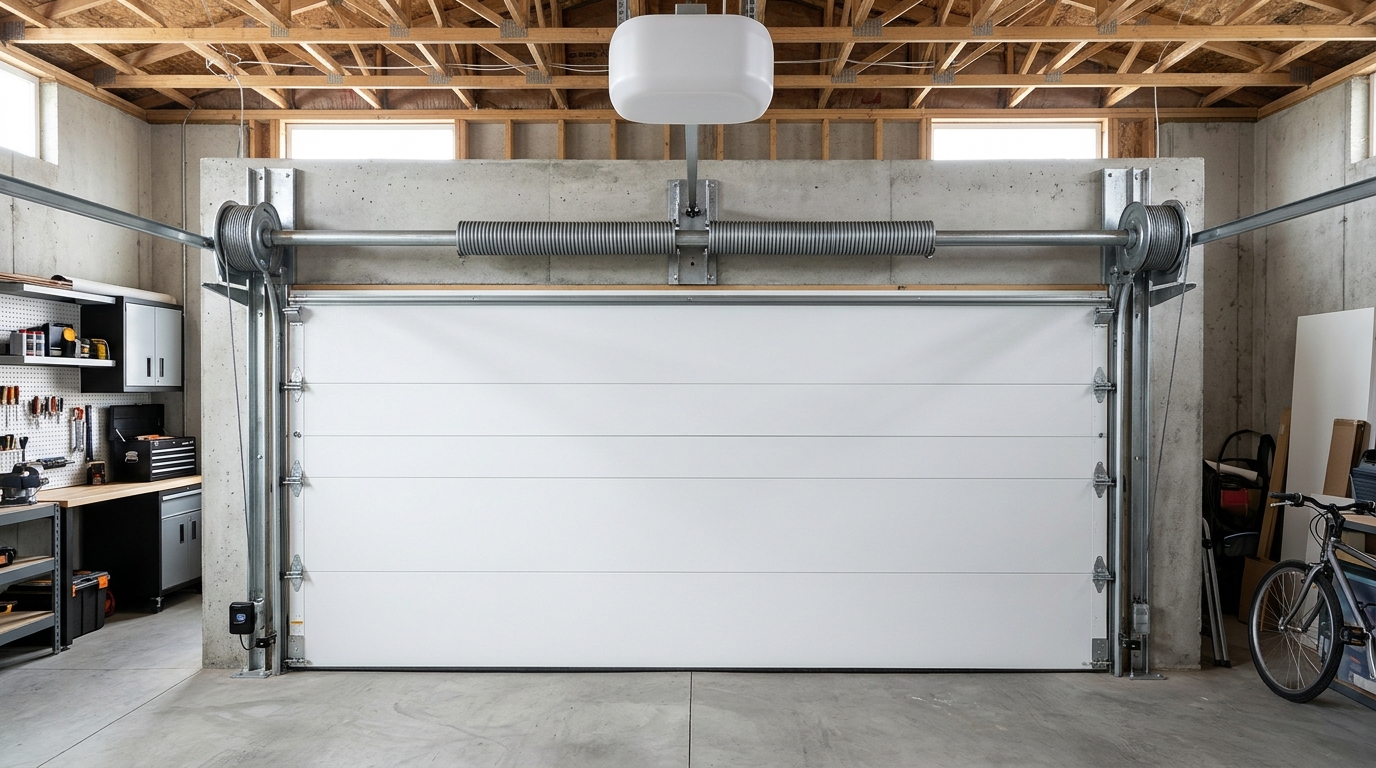
What federal clearance and frequency standards govern residential garage doors?
Visual engineering diagram showing 16 CFR Part 1211 photo-eye heights (6 inches max), 2-second reversal limits, torsion containment boundaries, and 380-399.9 MHz military LMR interference bands.
How do homeowners pair remotes, align photo-eyes, and release doors safely?
Verified answers covering LiftMaster Learn button sequences, 16 CFR 1211.11 photo-eye alignment under 6 inches, and broken torsion spring release prohibitions.
How do you program a LiftMaster or Chamberlain garage door opener?
Press and release the colored Learn button on the powerhead (Yellow = Security+ 2.0 tri-band; Purple = 315 MHz), then press the remote button within 30 seconds until the motor light flashes.
How do you align and fix garage door safety sensors?
Under 16 CFR 1211.11, mount photo-eyes <= 6 inches above the floor facing cleanly until both sender (amber) and receiver (green) LEDs stay solid without blinking.
How do you manually open a garage door safely?
ONLY pull the red emergency cord when the door is fully CLOSED. If a torsion spring above the header has a visible gap and the door is open, keep clear and call a technician.
Which garage hardware parts require licensed technicians vs DIY?
Compare ASTM A227 torsion springs, 7x19 lift cables, rollers, and weather seals with U.S. cost ranges, cycle lifespans, and UL 325 entrapment boundaries.
- Garage Door Torsion Springs (IPPT & ASTM A227) — $180 - $380 (pair installed)
- Garage Door Torsion & Extension Lift Cables — $120 - $240 (installed)
- Garage Door Bottom Astragal Seal (T-End / Bead / U-Shaped) — $25 - $65 (DIY materials)
- Garage Door Insulation Kits (EPS vs Polyiso vs Fiberglass) — $70 - $190 (single/double kit)
- UL 325 Photoelectric Safety Reversing Sensors — $45 - $110 (OEM kit)
How do LiftMaster, Genie, and Craftsman Learn buttons differ?
Match opener powerhead Learn button colors (Yellow Security+ 2.0, Purple 315 MHz, Green/Red 390 MHz) to remote and HomeLink car pairing rules.
- LiftMaster / Chamberlain: Remote & Wall Control Programming (Yellow Learn Button)
- LiftMaster / Chamberlain: 315 MHz Security+ Remote Programming (Purple Learn Button)
- Genie: Intellicode 1 & 2 Remote Pairing (PRGM / Set Button)
- HomeLink (In-Vehicle): In-Car Mirror Visor Button Pairing with Rolling Code Openers
- myQ / Wireless Keypad: Wireless Exterior Keypad PIN Setup (877MAX / 878MAX)
Where do 390 MHz garage remotes suffer military RF interference?
Affected ZIP codes surrounding major U.S. military bases running trunked Land Mobile Radio (380-399.9 MHz) systems under 47 CFR 15.231 secondary status.
- Joint Base San Antonio (Lackland / Randolph / Fort Sam Houston) (TX)
- Naval Station Norfolk & Joint Expeditionary Base Little Creek (VA)
- Fort Liberty (formerly Fort Bragg) (NC)
- Marine Corps Base Camp Pendleton & MCAS Miramar (CA)
- Eglin Air Force Base & Hurlburt Field (FL)
- Joint Base Lewis-McChord (JBLM) (WA)
- Wright-Patterson Air Force Base (OH)
- Fort Cavazos (formerly Fort Hood) (TX)
Which federal eCFR regulations govern residential garage door safety?
Exact 16 CFR Part 1211 entrapment sensor installation heights and reversal timings alongside 47 CFR 15.231 transmitter duty-cycle rules codified in federal law.
| CFR Citation | Requirement / Metric | Excerpt / Scope |
|---|---|---|
| 16 CFR Part 1211 (§ 1211.1) | § 1211.1 Effective date. [U.S. Consumer Product Safety Commission / eCFR] | This standard applies to all residential garage door operators manufactured on or after January 1, 1993 for sale in the United States. |
| 16 CFR Part 1211 (§ 1211.2) | § 1211.2 Definition. [U.S. Consumer Product Safety Commission / eCFR] | As used in this part 1211: Residential garage door operator means a vehicular door operator which: |
| 16 CFR Part 1211 (§ 1211.3) | § 1211.3 Units of measurement. [U.S. Consumer Product Safety Commission / eCFR] | If a value for measurement is followed by a value in other units, in parentheses, the second value may be only approximate. The first stated value is the requirement. |
| 16 CFR Part 1211 (§ 1211.4) | § 1211.4 General requirements for protection against risk of injury. [U.S. Consumer Product Safety Commission / eCFR] | ( a ) If an automatically reset protective device is employed, automatic restarting of a motor shall not result in a risk of injury to persons. |
| 16 CFR Part 1211 (§ 1211.5) | § 1211.5 General testing parameters. [U.S. Consumer Product Safety Commission / eCFR] | ( a ) The following test parameters are to be used in the investigation of the circuit covered by § 1211.4(c) for compliance with either, UL 991, or Supplement SA of UL 325-2017 (incorporated by reference, see § 1211.40 ): |
| 16 CFR Part 1211 (§ 1211.6) | § 1211.6 General entrapment protection requirements. [U.S. Consumer Product Safety Commission / eCFR] | ( a ) A residential garage door operator system shall be provided with inherent primary entrapment protection that complies with the requirements as specified in § 1211.7 . |
FAQ
Clear answers to 8 common repair, safety, cost, and licensing questions backed by official government records and manufacturer manuals.
How high must garage door safety sensors sit under federal code?
Under 16 CFR Part 1211 (16 CFR 1211.11), residential photoelectric entrapment sensors must be mounted no higher than 6 inches above the garage floor.
How fast must a residential garage door reverse upon hitting an obstruction?
Federal rule 16 CFR 1211.7 mandates automatic reversal within 2 seconds when the downward door contacts a flat 2x4 block on the garage floor.
When is pulling the red emergency release cord dangerous?
Never pull the red release cord while a heavy residential garage door is open above a broken torsion spring; unsupported doors weighing 150-350+ lbs can drop violently.
How do you measure garage torsion spring wire size safely?
Only measure an unwound spring (zero tension) across 20 coils with a ruler or calipers; never loosen set screws or touch red winding cones under tension.
Why do 390 MHz garage remotes lose range near military bases?
Under 47 CFR 15.231, residential garage remotes operate secondary to federal DoD Land Mobile Radio systems; upgrading to 315 MHz or tri-band Security+ 2.0 restores range.
What does California SB-969 require for garage door openers?
California Health and Safety Code 19890-19892 requires integrated DC battery backup on residential openers sold or installed in CA, backed by a $1,000 civil penalty.
Why do LED light bulbs interfere with garage opener remotes?
Certain unshielded LED bulbs emit electromagnetic noise in the 315-390 MHz range near the motor antenna; swap to low-EMI garage-rated LEDs if range drops when lights turn on.
Who should NOT adjust garage door torsion springs DIY?
All homeowners lacking wound-bar training should avoid torsion springs and bottom lift cables; contact a residential door technician with solid winding bars.
Related guides
Sources
- 16 CFR Part 1211 - Safety Standard for Automatic Residential Garage Door Operators — U.S. Consumer Product Safety Commission / eCFR, 2026-11-18 (retrieved 2026-11-23)
- 47 CFR Section 15.231 - Periodic Operation in the Band 40.66-40.70 MHz and Above 70 MHz — Federal Communications Commission (FCC) / eCFR, 2026-11-18 (retrieved 2026-11-23)
- UL 325 Standard for Door, Drapery, Gate, Louver, and Window Operators — UL Standards & Engagement, UL 325 7th Ed. (retrieved 2026-11-23)
- OEM Service & Owner Manuals (GE, Whirlpool, LG, Samsung, Frigidaire, Bosch, Speed Queen, LiftMaster, Chamberlain, Genie, Wayne Dalton, Schlage, Kwikset) — Respective Equipment Manufacturers, 2020-2026 OEM Technical Publications (retrieved 2026-11-23)