
Garage Door Torsion Spring Replacement Cost, Cycles & Warranty Rules
Standard 10,000-cycle ASTM A227 torsion spring pairs average $180 to $380 installed, whereas secondary lift cables (1/8 or 5/32-in 7x19 galvanized aircraft cable) average $120 to $240 installed when frayed or rusted. Because dual-spring garage shafts split torque equally, replacing only one broken coil leaves a heavily fatigued partner carrying 90%+ cumulative cycle wear that frequently fails within months. Note that routine spring fatigue is normally excluded by standard homeowner insurance and warranty wear caps.
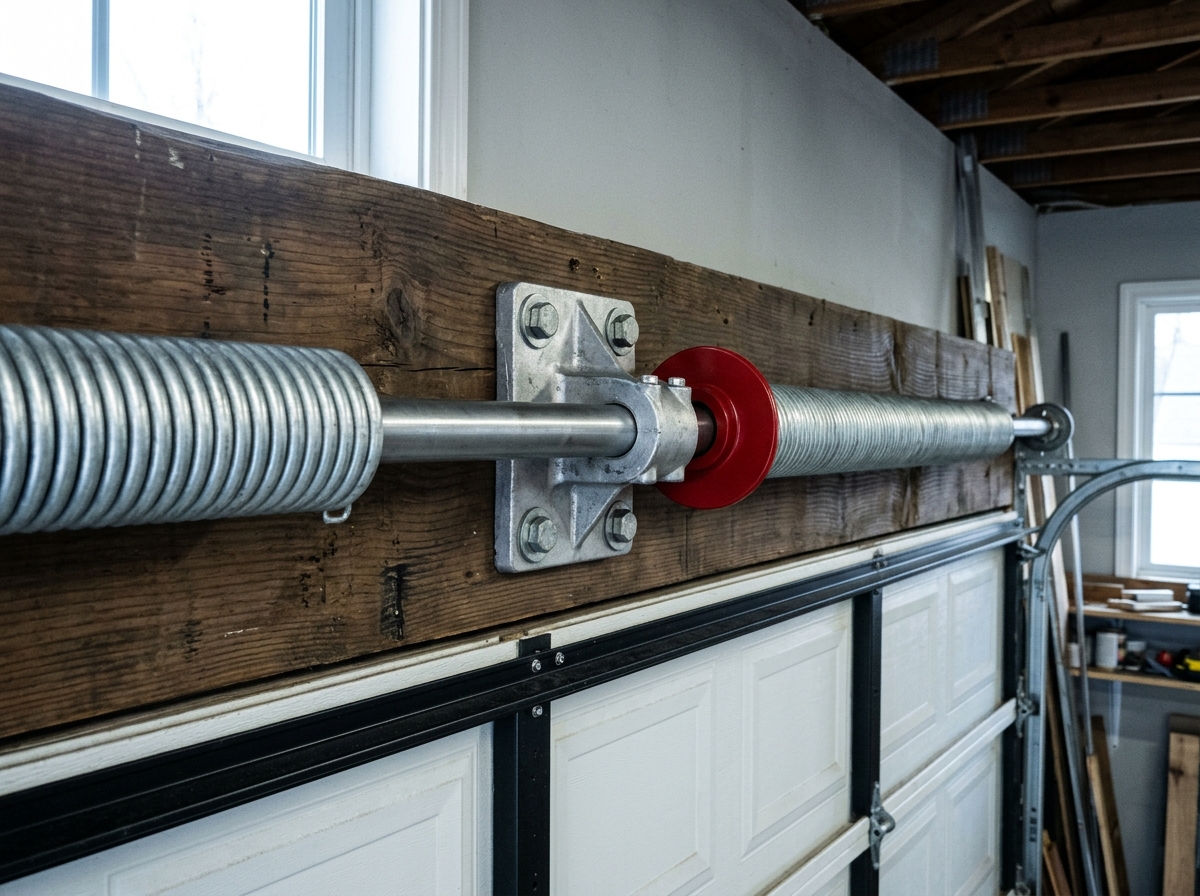
What cost and cycle metrics define garage door spring budgets?
Hardware estimates reflect paired coils, wire diameter (0.192 to 0.295 in), cycle life upgrades, and state contractor registration rules.
- Torsion Pair Installed
- $180 - $380 10,000 cycles
- Lift Cable Installed
- $120 - $240 7x19 aircraft
- Stored Shaft Torque
- 300 - 600 ft-lbs hazard
- Bottom Seal DIY Cost
- $25 - $65 5-8 yr life
- Insulation Weight Impact
- 15 - 35 lbs added
How do verified costs compare across garage door hardware parts?
Hardware benchmarks divide low-hazard DIY weatherproofing (astragal seals and photo-eye kits) from extreme-torque springs and bottom tension brackets.
| Component | Typical Cost Scope | Design Lifespan | DIY Hazard | Core Spec / Statutory Note |
|---|---|---|---|---|
| Garage Door Torsion Springs (IPPT & ASTM A227) | $180 - $380 (pair installed) | 10,000 standard cycles (~7-10 yrs) | pro_required | Sized by Wire Gauge (0.192" to 0.295" measured across 20 coils), Inside Diameter (1.75" or 2.00"), and Unwound Length. |
| Garage Door Torsion & Extension Lift Cables | $120 - $240 (installed) | 8-12 years | pro_required | 7x19 galvanized aircraft cable (1/8" residential standard for doors up to ~600 lbs; 5/32" for heavy wood/insulated doors). |
| UL 325 Photoelectric Safety Reversing Sensors | $45 - $110 (OEM kit) | 10-15 years | low | 16 CFR § 1211.11 mandates optical beam no higher than 6 inches above garage floor; door must reverse within 2 seconds upon obstruction. |
| Garage Door Insulation Kits (EPS vs Polyiso vs Fiberglass) | $70 - $190 (single/double kit) | 15+ years | low | Adding 15-35 lbs of foam panels can unbalance door; re-test door balance at half-open position with opener disconnected. |
| Garage Door Bottom Astragal Seal (T-End / Bead / U-Shaped) | $25 - $65 (DIY materials) | 5-8 years | low | Match retainer track profile: 1/4" single T-end (Clopay/Amarr), 5/16" T-end, P-bulb (Overhead Door), or beaded loop (Wayne Dalton). |
Why do 25,000-cycle spring upgrades cost less per year than 10,000-cycle pairs?
Upgrading wire size slightly longer boosts rated fatigue cycles by 2.5x while paying only one truck roll and winding setup fee.
- Daily cycle math for busy households: At 4 openings and closures per day (8 cycles daily across 2 drivers), a builder-grade 10,000-cycle coil reaches fatigue fracture in under 7 years.
- Simultaneous dual-spring pairing rule: Swapping both springs together prevents uneven left/right drum lift cable tension and avoids paying a duplicate diagnostic trip fee months later.
- DIY insulation panel balance check: Adding 15 to 35 lbs of foam insulation requires spring balance re-calibration and fresh 16 CFR 1211 down-force reversal testing. [Respective Equipment Manufacturers]
Who should choose DIY diagnostics vs hiring a licensed specialist?
Select single-pair replacement, high-cycle upgrades, or contractor verification before approving a garage door spring invoice. Compare statutory rules, regional BLS trade wages, and mechanical hazard boundaries carefully before commissioning repairs.
Ideal for secondary detached garages or homes averaging 2 to 3 door cycles daily with intact lift cables and nylon rollers.
Avoid when: Replacing just one broken spring on a two-spring overhead shaft.
Fits multi-driver family homes using the garage as the main daily entry door (6+ cycles daily) or heavier insulated doors.
Avoid when: Expecting home warranty contracts to cover routine cycle fatigue without mechanical coverage riders.
Recommended in coastal salt air or northern road-salt garages where bottom bracket cables fray alongside snapped coils.
Avoid when: Unwinding rusted bottom bracket bolts yourself (cables remain under live spring tension even near the floor).
What are the limitations of these technical reference tables?
CodeBench benchmark lists trace to U.S. government open datasets, eCFR standards, and state statutes as of 2026 and are not a substitute for active factory warranties, municipal permits, or commercial engineering stamps.
Who should NOT rely on this list
- Who should NOT rely on out-of-warranty benchmarks: owners inside a 1-year warranty or open recall should contact the manufacturer first.
- Not a substitute for licensed trade permits on 240V circuits, gas manifolds, sealed cooling loops, or torsion springs.
- Not an affiliated OEM service desk: CodeBench maintains independent verification records only.
Which option fits your situation?
- Safe DIY checks: Limit work to unplugged cleaning, coin traps, serial decoding, and low-voltage photo-eye alignment.
- High-energy or sealed components: Escalate R-600a lines, 240V relays, gas valves, and wound torsion springs to qualified pros.
Which diagnostic tools and state hubs connect to this topic?
Use the linked CodeBench datasets, model directories, and state wage/licensing hubs below to verify parts, labor benchmarks, and municipal contractor registries.
- Safe Zero-Touch Spring Measurement Count 20 coils & ID without loosening cones
- Torsion vs Extension Spring Comparison Safety containment, balance & hardware cycles
- Garage Door Opener Diagnostics 6-inch stop triage caused by broken coils
- Verify State Door Contractor Rules Check CA D-28, FL CILB, OR CCB & WA L&I
FAQ
Clear answers to 7 common repair, safety, cost, and licensing questions backed by official government records and manufacturer manuals.
How much would it cost to fix my garage door?
Verified hardware benchmarks put DIY bottom seal replacement at $25-$65 and OEM 16 CFR 1211 safety sensor kits at $45-$110, whereas pro-required high-torque torsion spring pairs average $180-$380 installed and lift cable repairs run $120-$240 installed depending on door weight and regional labor.
How much does a garage door spring usually cost?
A standard 10,000-cycle ASTM A227 torsion spring pair installed typically falls in the $180 to $380 hardware-and-install benchmark, while upgrading to high-cycle 25,000+ wire adds moderate wire cost and triples service life on busy multi-driver households.
What is the most common problem with garage doors?
Fatigued torsion or extension springs, misaligned photoelectric safety beams (required <= 6 inches off the floor by 16 CFR 1211), frayed lift cables, and out-of-adjustment travel/force limits account for the vast majority of residential garage door failures.
What is the most common garage door repair?
Broken torsion springs—snapping with a loud bang once coils exceed their 10,000-cycle fatigue rating after 7 to 10 years—are the single most frequent repair, followed by photo-eye sensor realignment and stripped nylon drive gears.
Can you replace just one spring on a garage door?
Replacing only one spring on a two-spring torsion shaft leaves a fresh spring paired with an aged partner carrying 90%+ cumulative fatigue; the older coil usually snaps within months, incurring a second trip fee and causing uneven drum pull.
Are all garage door torsion springs the same?
No—torsion springs must match wire diameter (0.192 to 0.295 in), inside coil diameter (1-3/4 or 2 in), wind direction (left vs right), and active coil length to hit exact IPPT balance for a 150-350+ lb door; wrong IPPT overloads the opener gear.
What's the average lifespan of a garage door spring?
Standard builder-grade 10,000-cycle torsion springs last roughly 7 to 10 years at 3 to 4 daily cycles, whereas cold winter steel shock and added DIY insulation weight (15 to 35 lbs) shorten fatigue intervals unless high-cycle coils are specified.
Related guides
Sources
- OEM Service & Owner Manuals (GE, Whirlpool, LG, Samsung, Frigidaire, Bosch, Speed Queen, LiftMaster, Chamberlain, Genie, Wayne Dalton, Schlage, Kwikset) — Respective Equipment Manufacturers, 2020-2026 OEM Technical Publications (retrieved 2026-11-23)
- 16 CFR Part 1211 - Safety Standard for Automatic Residential Garage Door Operators — U.S. Consumer Product Safety Commission / eCFR, 2026-11-18 (retrieved 2026-11-23)
- California Health & Safety Code Sections 19890-19892 (SB-969 Garage Door Battery Backup) — California State Legislature, CA HSC 2019-2026 (retrieved 2026-11-23)
- CPSC Recalls REST Web Services API (SaferProducts.gov) — U.S. Consumer Product Safety Commission (CPSC), REST JSON 2026 (retrieved 2026-11-23)