
Garage Door Opener Repair: 6-Inch Stops, Reversals & Flash Codes
When a garage door stops after lifting 6 inches—or reverses cleanly just before touching the concrete slab—the root problem almost never sits inside the wall button. Sudden 6-inch halts indicate extreme excessive spring weight tripping overload sensors (check for snapped torsion coils overhead first) or stripped nylon drive gears, while immediate reversal triggers stem from misaligned 16 CFR Part 1211 photoelectric safety beams mounted within 6 inches of the floor, requiring downward reversal within 2 seconds.
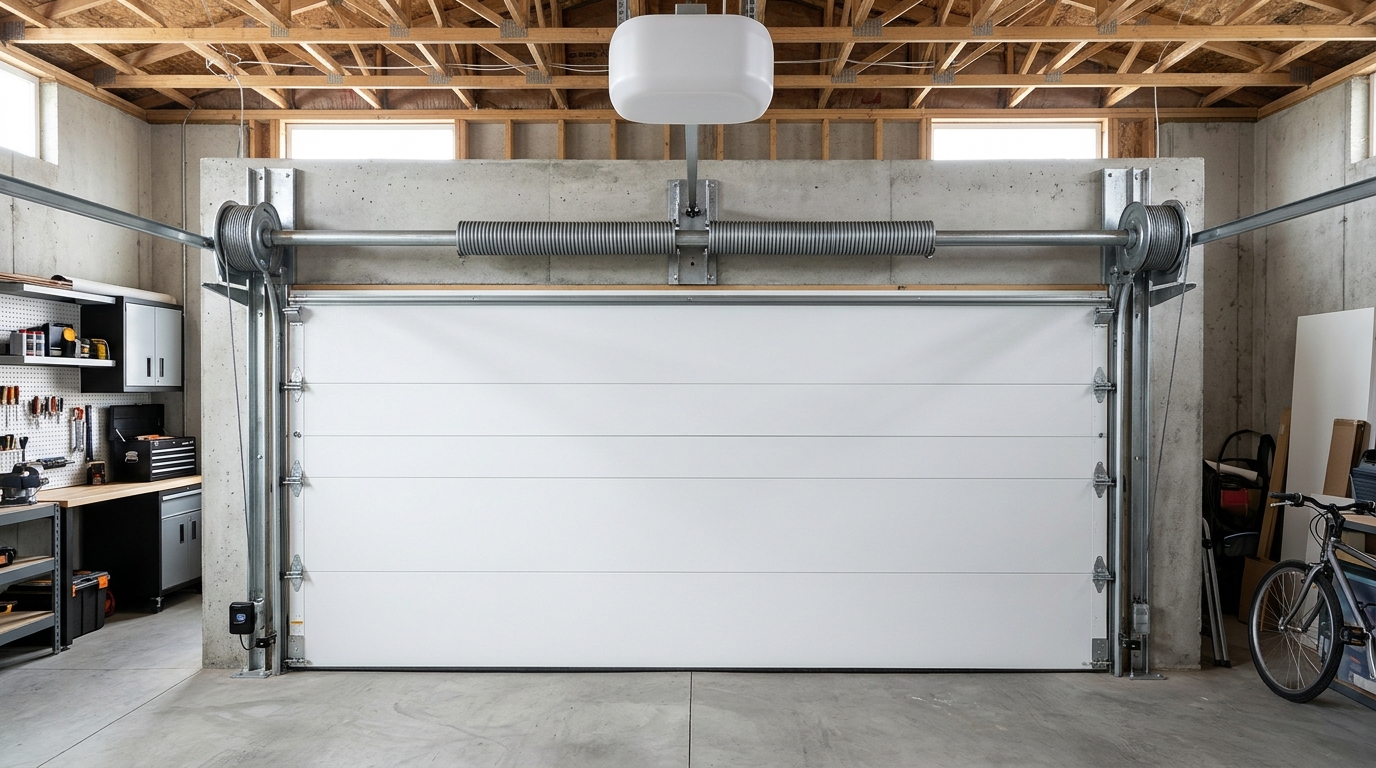
What federal safety and RF rules govern garage door opener repairs?
Verify post-1993 federal entrapment rules, sensor alignment geometry, and LED fault blinks before buying logic boards or safety eyes.
- Safety Eye Max Height
- <= 6 inches above slab
- Mandatory Reverse Time
- <= 2 seconds
- UL 325 Federal Cutoff
- 1993 mandatory eyes
- OEM Sensor Kit Cost
- $45 - $110 hardware norm
- CA SB 969 Civil Penalty
- $1,000 non-battery unit
Why does a garage door open 6 inches and stop or reverse before closing?
Pulling the red emergency release cord with the door CLOSED safely isolates mechanical spring balance from electric motor gear and sensor errors.
| Observed Failure | Primary Suspect | Diagnostic Test | Fix vs Safety Cutoff |
|---|---|---|---|
| Lifts 6 inches and halts hard | Snapped torsion spring or broken cable | Inspect spring coils overhead; never pull cord when door is open | Pro-only spring swap ($180-$380) |
| Reverses mid-down, wall light blinks 10x | Blocked/misaligned safety sensors | Check green/amber LED alignment <= 6 in off floor | Realign brackets or swap kit ($45-$110) |
| Motor hums, chain/belt won't move | Stripped nylon worm gear or dead cap | Peek inside motor cover for white plastic dust | DIY gear/capacitor kit or unit replace |
| Opens intermittent / weak range | LED bulb RF noise or 390 MHz base trunking | Remove opener LED bulbs temporarily to test range | Low-EMI bulbs or dual-frequency receiver |
How do you decode LiftMaster and Genie blinking opener LEDs?
Modern DC operators count directional arrow or round LED flashes to separate encoder travel-module loss from wiring shorts and thermal trips.
| Platform | Error Code / Signal | Root Diagnosis | Verification Path |
|---|---|---|---|
| LiftMaster / Chamberlain | Remote & Wall Control Programming (Yellow Learn Button) | 310 / 315 / 390 MHz Tri-Band Security+ 2.0 | Locate Yellow circular Learn button on powerhead side/rear panel. -> Press and immediately release Learn button (LED glows steady for 30 seconds). |
| LiftMaster / Chamberlain | 315 MHz Security+ Remote Programming (Purple Learn Button) | 315 MHz Rolling Code | Press and release Purple Learn button on powerhead. -> Within 30 seconds, press and hold remote button until opener light blinks. |
| Genie | Intellicode 1 & 2 Remote Pairing (PRGM / Set Button) | 315 / 390 MHz Dual-Frequency Auto-Seek | Press and hold PRGM/Set button until round LED turns blue, then release (long purple LED flashes). -> Press remote button twice slowly until opener activates. |
| HomeLink (In-Vehicle) | In-Car Mirror Visor Button Pairing with Rolling Code Openers | 288 - 433 MHz (Compatibility Bridge needed for pre-2013 cars on Security+ 2.0) | Clear vehicle HomeLink memory by holding outer two buttons 10-20s until fast flash. -> Hold handheld opener remote 1-3 inches from HomeLink button and press both until indicator changes. |
| myQ / Wireless Keypad | Wireless Exterior Keypad PIN Setup (877MAX / 878MAX) | 310 / 315 / 390 MHz | Press and release Learn button on garage opener motor. -> Within 30 seconds, enter new 4-digit PIN on exterior keypad. |
Who should choose DIY diagnostics vs hiring a licensed specialist?
Decide when alignment or OEM sensor swaps resolve faults vs mandatory full opener upgrade under 16 CFR 1211 and CA SB 969.
Ideal when sunlight blinds an eye, spiderwebs cross the lens, or wall brackets twist slightly off-level.
Avoid when: Bypassing or mounting 16 CFR 1211 safety sensors on the ceiling above the door opener.
Fits doors feeling heavy manually (<15 lb manual hold test failed) or stripped drives paired with aged springs.
Avoid when: Forcing travel force pots higher to compensate for fatigued springs.
Recommended on all pre-1993 non-sensor operators and required by law in California (SB 969 wildfire outage mandate).
Avoid when: Installing legacy 390 MHz receivers near DoD military trunking installations.
What are the limitations of these technical reference tables?
CodeBench benchmark lists trace to U.S. government open datasets, eCFR standards, and state statutes as of 2026 and are not a substitute for active factory warranties, municipal permits, or commercial engineering stamps.
Who should NOT rely on this list
- Who should NOT rely on out-of-warranty benchmarks: owners inside a 1-year warranty or open recall should contact the manufacturer first.
- Not a substitute for licensed trade permits on 240V circuits, gas manifolds, sealed cooling loops, or torsion springs.
- Not an affiliated OEM service desk: CodeBench maintains independent verification records only.
Which option fits your situation?
- Safe DIY checks: Limit work to unplugged cleaning, coin traps, serial decoding, and low-voltage photo-eye alignment.
- High-energy or sealed components: Escalate R-600a lines, 240V relays, gas valves, and wound torsion springs to qualified pros.
Which diagnostic tools and state hubs connect to this topic?
Use the linked CodeBench datasets, model directories, and state wage/licensing hubs below to verify parts, labor benchmarks, and municipal contractor registries.
- Garage Opener Installation Cost Guide Belt vs chain drive, SB 969 backup & pro licensing
- Belt-Drive vs Chain-Drive Comparison Noise ratings, tensile belts & headroom checks
- LiftMaster 1-Up / 1-Down Error Code Safety beam open wire & travel sensor faults
- 390 MHz Military Base RF Interference Protect remote range under 47 CFR 15.231
FAQ
Clear answers to 7 common repair, safety, cost, and licensing questions backed by official government records and manufacturer manuals.
How much would it cost to fix my garage door?
Verified hardware benchmarks put DIY bottom seal replacement at $25-$65 and OEM 16 CFR 1211 safety sensor kits at $45-$110, whereas pro-required high-torque torsion spring pairs average $180-$380 installed and lift cable repairs run $120-$240 installed depending on door weight and regional labor.
How much is it to fix a garage door opener?
Replacing OEM safety eye kits ($45-$110) or external receivers fixes most false reversals cleanly. When pre-1993 operators lack 16 CFR Part 1211 photoelectric beams—or in California where SB 969 battery-backup rules carry $1,000 statutory penalties—full operator replacement beats board repair.
What's the average cost to put in a garage door opener?
Opener installation projects reflect head unit type (chain vs belt vs jackshaft), rail length (7 ft vs 8 ft doors), ceiling framing, and whether backup batteries (mandated under California SB 969) or HomeLink compatibility bridges are included.
Is it worth repairing a 20 year old garage door opener?
If a 20-year-old opener needs a new logic board or motor assembly, replacing the head unit with a UL 325 / 16 CFR 1211 Security+ 2.0 or dual-frequency unit is usually safer and eliminates 390 MHz military trunking interference near DOD installations.
How long does a LiftMaster garage door opener last?
Well-balanced residential LiftMaster and Chamberlain operators run 10 to 15 years on balanced springs; worn door springs that make a 200 lb door feel heavy rapidly strip nylon drive gears or burn out motor capacitors.
What is the life expectancy of a LiftMaster garage door opener?
Chain-drive and DC belt-drive LiftMaster openers routinely achieve 10 to 15 years when torsion balance keeps manual lift effort under 15 lbs at mid-travel and photo-eyes stay dry and aligned within 6 inches of the slab.
How do I reset my LiftMaster garage door opener?
Hold the colored Learn button (yellow for Security+ 2.0, purple for 315 MHz) for 6 full seconds until the adjacent LED turns off to wipe all old vehicle HomeLink and remote codes before programming replacement transmitters.
Related guides
Sources
- 16 CFR Part 1211 - Safety Standard for Automatic Residential Garage Door Operators — U.S. Consumer Product Safety Commission / eCFR, 2026-11-18 (retrieved 2026-11-23)
- 47 CFR Section 15.231 - Periodic Operation in the Band 40.66-40.70 MHz and Above 70 MHz — Federal Communications Commission (FCC) / eCFR, 2026-11-18 (retrieved 2026-11-23)
- California Health & Safety Code Sections 19890-19892 (SB-969 Garage Door Battery Backup) — California State Legislature, CA HSC 2019-2026 (retrieved 2026-11-23)
- UL 325 Standard for Door, Drapery, Gate, Louver, and Window Operators — UL Standards & Engagement, UL 325 7th Ed. (retrieved 2026-11-23)
- OEM Service & Owner Manuals (GE, Whirlpool, LG, Samsung, Frigidaire, Bosch, Speed Queen, LiftMaster, Chamberlain, Genie, Wayne Dalton, Schlage, Kwikset) — Respective Equipment Manufacturers, 2020-2026 OEM Technical Publications (retrieved 2026-11-23)
- CPSC Recalls REST Web Services API (SaferProducts.gov) — U.S. Consumer Product Safety Commission (CPSC), REST JSON 2026 (retrieved 2026-11-23)