
Residential ANSI/BHMA Lock Grades, Keyways & Door Prep
ANSI/BHMA A156.36 classifies residential deadbolts across Grade 1 (250,000 cycles, 10x 75 ft-lb strikes), Grade 2 (150,000 cycles), and Grade 3 (100,000 cycles). Compare Schlage SC1 vs Kwikset KW1 keyways, print standard 2-1/8 inch bore templates, and audit lockout quotes against FTC bait-and-switch traps. All figures come directly from EPA ENERGY STAR, EIA utility records, CPSC and NHTSA safety recalls, federal safety standards, Bureau of Labor Statistics wages, and public state licensing boards for U.S. out-of-warranty home repairs.
- Grade 1 Endurance
- 250,000 cycles / 10 blows
- Grade 2 Endurance
- 150,000 cycles / 5 blows
- Standard Bore / Throw
- 2-1/8 in bore / 1 in throw
- US Locksmith Wage
- $22.96/hr median (Locksmith)
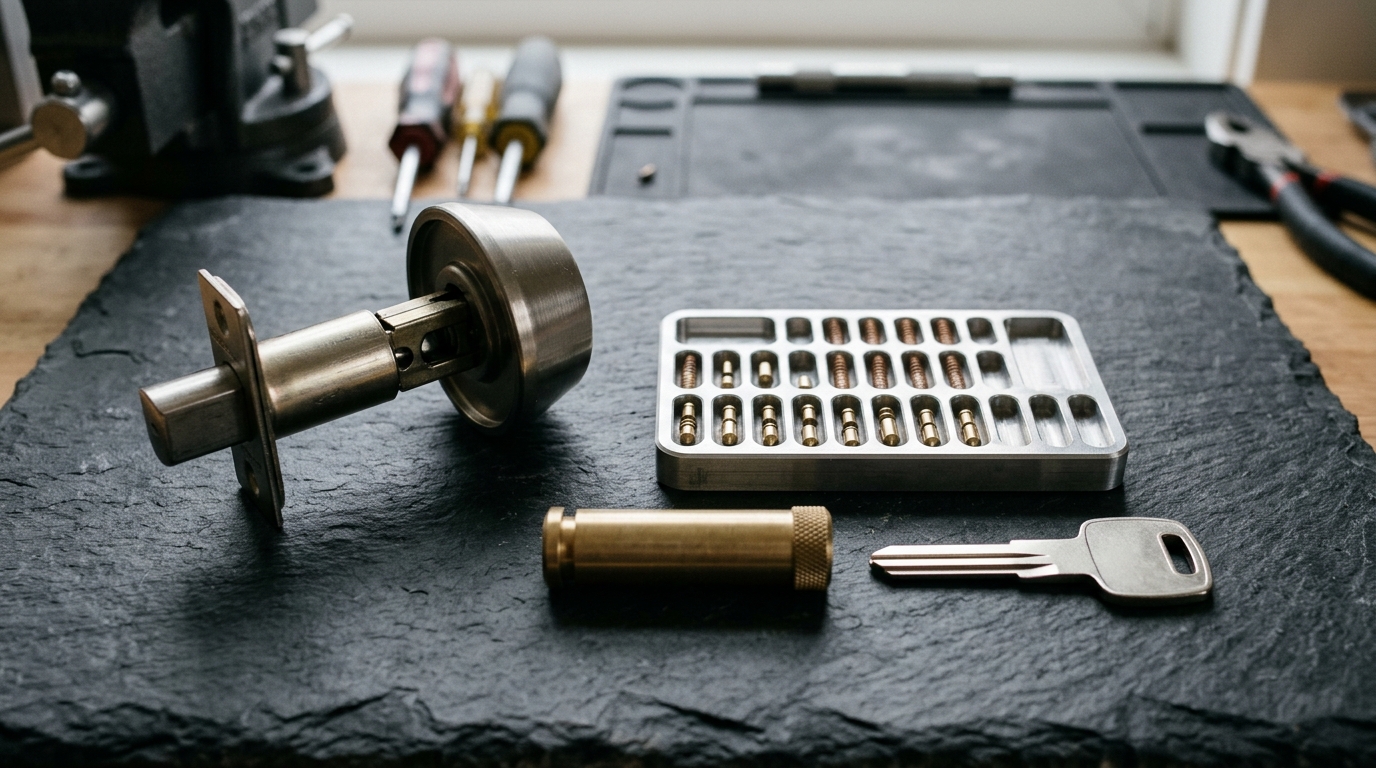
How much do locksmiths cost and what do licensing rules require?
Verify BLS locksmith median labor rates, FTC $15-$29 call-out scam indicators, and standard homeowners insurance exclusion rules before calling local dispatch.
How much does a locksmith cost for a house lockout or rekey?
BLS reports a $22.96/hr national locksmith median wage. Confirm a written total covering service call, labor, and cylinders, and avoid $15-$29 bait-and-switch ads.
Does renters or homeowners insurance cover a locksmith?
Standard policies rarely cover lost keys without a specific lock-and-key endorsement or deductible waiver, so compare upfront quotes against lock replacement cost.
What are the standard residential door cross-bore and backset dimensions?
North American residential exterior doors specify a 2-1/8 inch cross-bore, 1 inch edge bore, 2-3/8 or 2-3/4 inch adjustable backset, and 1 inch deadbolt throw across 1-3/8 to 1-3/4 inch door thickness.
What are the limitations of ENERGY STAR chassis lists?
ENERGY STAR catalog pages benchmark annual kWh draw and capacity across 5 certified residential chassis and exclude non-certified budget models, commercial NSF units, and live retail stock prices.
Who should NOT rely on this list
- Who should NOT rely on residential kWh tables: commercial kitchens and coin-op laundries require industrial ratings.
- Not a substitute for tape measurement: verify cutout width, door swing, and 1-2 inches rear condenser airflow clearance.
- Not a parts store: finish suffixes collapse onto one appliance models, and regional retail availability varies.
Which option fits your situation?
- High electricity rate states: Target top-quartile lowest-kWh models to maximize 10-year EIA utility savings.
- Tight 24-inch or 33-inch alcove swap: Match exact cutout width first, then compare peer energy density.
- Out-of-warranty repair decision: Look up your appliance models kWh and run the 50% repair-vs-replace calculation.
How do ANSI/BHMA A156.36 Grade 1, 2, and 3 standards compare?
Side-by-side matrix comparing deadbolt hammer-strike impact ratings, 250,000 vs 100,000 test cycle limits, and Schlage SC1 vs Kwikset KW1 cylinder keyway tolerances.
| Standard / Keyway | Grade / Profile | Cycles / Pins | Bolt / Spec |
|---|---|---|---|
| ANSI/BHMA A156.36 Grade 1 Residential/Commercial Deadbolt | Grade 1 | 250,000 cycles | 1 inch minimum solid/hardened pin throw |
| ANSI/BHMA A156.36 Grade 2 Light-Commercial / Heavy Residential Deadbolt | Grade 2 | 150,000 cycles | 1 inch minimum throw |
| ANSI/BHMA A156.36 Grade 3 Standard Residential Deadbolt | Grade 3 | 100,000 cycles | 1 inch throw (or 5/8 in legacy latch) |
| Schlage C Keyway (Ilco SC1 5-Pin / SC4 6-Pin) | SC1 / SC4 | 5-pin (SC1) / 6-pin (SC4) | 0.015 in pin depth increment |
| Kwikset Keyway (Ilco KW1 5-Pin / SmartKey) | KW1 / SmartKey | 5-pin (KW1) / 6-pin (KW10) | 0.023 in pin depth increment |
FAQ
Clear answers to 8 common repair, safety, cost, and licensing questions backed by official government records and manufacturer manuals.
How does ANSI/BHMA A156.36 distinguish Grade 1, Grade 2, and Grade 3 deadbolts?
Grade 1 endures 250,000 cycles and 10 blows at 75 ft-lbs, Grade 2 endures 150,000 cycles and 5 blows, and Grade 3 handles 100,000 cycles and 2 blows.
What is standard US residential door prep for deadbolts?
Most US exterior residential doors use a 2-1/8 in cross-bore, 1 in edge bore, 1-3/8 to 1-3/4 in thickness, and adjustable 2-3/8 or 2-3/4 in backset.
How long should strike plate screws be on an exterior deadbolt?
Anchor heavy-duty strike plates with 3-inch #10 structural wood screws reaching into wall framing studs rather than relying solely on short 3/4-inch jamb trim screws.
What is the difference between Schlage SC1 and Kwikset KW1 keyways?
SC1 uses 5 pins with 0.015 in depth increments (depths 0-9), while KW1 uses 5 pins with 0.023 in steps (depths 1-6) and optional 15-second SmartKey rekeying.
How can you spot a $19 locksmith bait-and-switch ad?
FTC consumer alerts warn against $15-$29 dispatch ads using unmarked subcontractors who demand cash and insist on drilling standard pin-tumbler deadbolts instead of picking them.
Which US states require centralized state locksmith licensing?
Eleven states enforce centralized boards (AL, CA, IL, LA, MD, NC, NJ, OK, OR, TX, VA), plus CT DCP, NV sheriff cards, and NYC DCWP; TN, NE, and FL have no statewide license.
Do residential smart deadbolts use the same bore size?
Yes; Schlage, Kwikset, and Yale ANSI/BHMA smart deadbolts fit standard 2-1/8 in cross-bores and 1 in deadbolt throws when door alignment is square.
Who should NOT force a binding smart deadbolt motor?
If a motorized deadbolt stalls or flashes low-battery alerts, adjust the strike pocket depth and swap fresh AA alkaline batteries rather than forcing internal drive gears.
Related guides
Sources
- BHMA Certified Products Directory (ANSI/BHMA A156.2 & A156.36 Grade 1/2/3 Locks) — Builders Hardware Manufacturers Association (BHMA), A156.2 / A156.36 (retrieved 2026-11-23)
- Consumer Advice: Avoiding Locksmith Bait-and-Switch Scams — Federal Trade Commission (FTC), 2026 (retrieved 2026-11-23)
- US State Locksmith & Garage Contractor Regulatory Boards (50 States + DC: AL AESBL, CA BSIS/CSLB, IL IDFPR, LA OSFM, MD DLLR, NC NCLB, NJ DCA, OK DOL, OR CCB, TX DPS, VA DCJS/DPOR, CT DCP) — US State Licensing Boards, 2025-2026 Verification Matrix (retrieved 2026-11-23)