
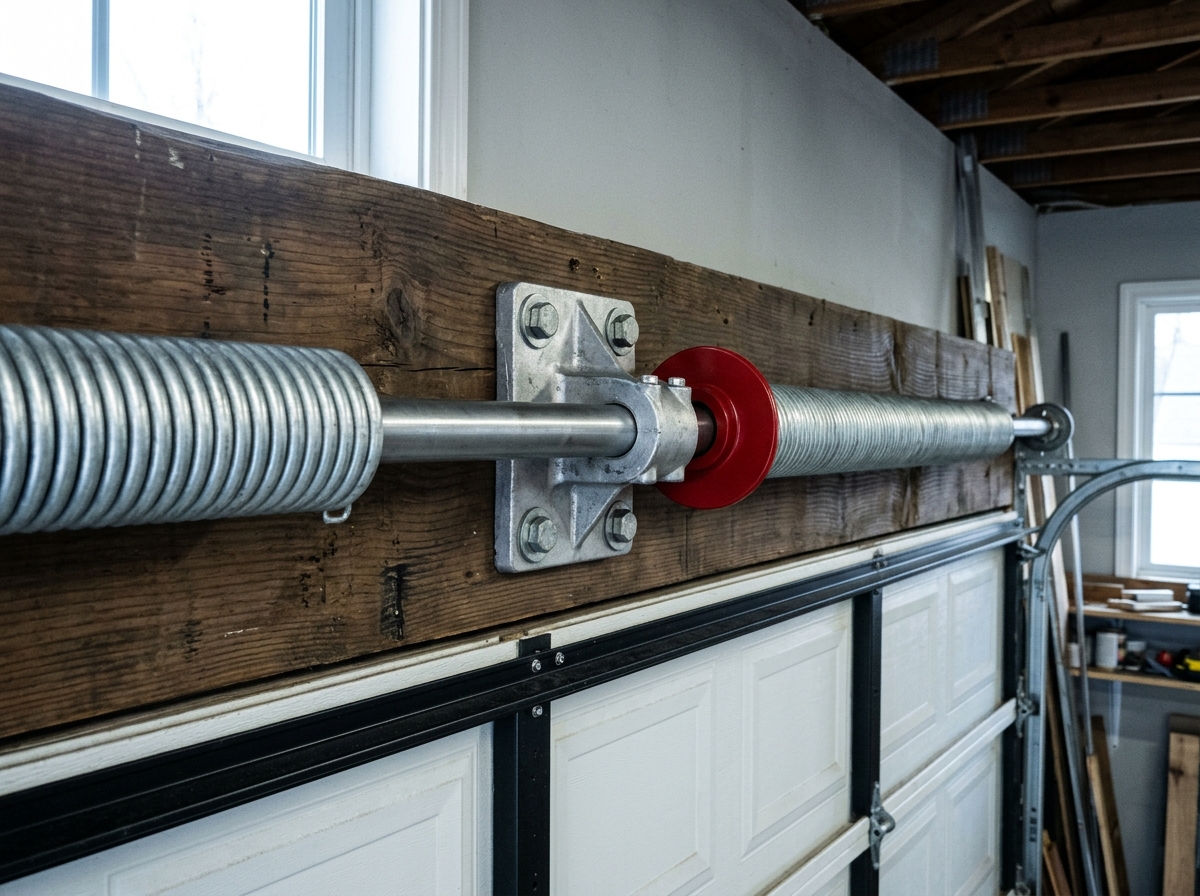
Garage Door Torsion Springs (IPPT & ASTM A227)
Sized by Wire Gauge (0.192" to 0.295" measured across 20 coils), Inside Diameter (1.75" or 2.00"), and Unwound Length. Typical residential service life is 10,000 standard cycles (~7-10 yrs); U.S. installed cost ranges from $180 - $380 (pair installed). PRO REQUIRED: Stored torque exceeds 300-600 ft-lbs; Wayne Dalton TorqueMaster enclosed shafts and standard torsion springs carry severe laceration/impact risk.
- Residential Price
- $180 - $380 (pair installed)
- Cycle Life
- 10,000 standard cycles (~7-10 yrs)
- DIY Tier
- Pro Required (high voltage, gas, sealed cooling, or torsion spring)
What federal clearance and frequency standards govern residential garage doors?
Visual engineering diagram showing 16 CFR Part 1211 photo-eye heights (6 inches max), 2-second reversal limits, torsion containment boundaries, and 380-399.9 MHz military LMR interference bands.
- DIY Hazard Level
- Pro Required (High Stored Energy)
- Reference Cost Range
- $180 - $380 (pair installed)
- Service Life Benchmark
- 10,000 standard cycles (~7-10 yrs)
- Primary Spec
- Sized by Wire Gauge (0.192" to 0.295" measured across 20 coils), Inside Diameter (1.75" or 2.00"), and Unwound Length.
Which federal eCFR regulations govern residential garage door safety?
Exact 16 CFR Part 1211 entrapment sensor installation heights and reversal timings alongside 47 CFR 15.231 transmitter duty-cycle rules codified in federal law.
| CFR Citation | Requirement / Metric | Excerpt / Scope |
|---|---|---|
| 16 CFR Part 1211 (§ 1211.1) | § 1211.1 Effective date. [U.S. Consumer Product Safety Commission / eCFR] | This standard applies to all residential garage door operators manufactured on or after January 1, 1993 for sale in the United States. |
| 16 CFR Part 1211 (§ 1211.2) | § 1211.2 Definition. [U.S. Consumer Product Safety Commission / eCFR] | As used in this part 1211: Residential garage door operator means a vehicular door operator which: |
| 16 CFR Part 1211 (§ 1211.3) | § 1211.3 Units of measurement. [U.S. Consumer Product Safety Commission / eCFR] | If a value for measurement is followed by a value in other units, in parentheses, the second value may be only approximate. The first stated value is the requirement. |
| 16 CFR Part 1211 (§ 1211.4) | § 1211.4 General requirements for protection against risk of injury. [U.S. Consumer Product Safety Commission / eCFR] | ( a ) If an automatically reset protective device is employed, automatic restarting of a motor shall not result in a risk of injury to persons. |
FAQ
Clear answers to 8 common repair, safety, cost, and licensing questions backed by official government records and manufacturer manuals.
How high must garage door safety sensors sit under federal code?
Under 16 CFR Part 1211 (16 CFR 1211.11), residential photoelectric entrapment sensors must be mounted no higher than 6 inches above the garage floor.
How fast must a residential garage door reverse upon hitting an obstruction?
Federal rule 16 CFR 1211.7 mandates automatic reversal within 2 seconds when the downward door contacts a flat 2x4 block on the garage floor.
When is pulling the red emergency release cord dangerous?
Never pull the red release cord while a heavy residential garage door is open above a broken torsion spring; unsupported doors weighing 150-350+ lbs can drop violently.
How do you measure garage torsion spring wire size safely?
Only measure an unwound spring (zero tension) across 20 coils with a ruler or calipers; never loosen set screws or touch red winding cones under tension.
Why do 390 MHz garage remotes lose range near military bases?
Under 47 CFR 15.231, residential garage remotes operate secondary to federal DoD Land Mobile Radio systems; upgrading to 315 MHz or tri-band Security+ 2.0 restores range.
What does California SB-969 require for garage door openers?
California Health and Safety Code 19890-19892 requires integrated DC battery backup on residential openers sold or installed in CA, backed by a $1,000 civil penalty.
Why do LED light bulbs interfere with garage opener remotes?
Certain unshielded LED bulbs emit electromagnetic noise in the 315-390 MHz range near the motor antenna; swap to low-EMI garage-rated LEDs if range drops when lights turn on.
Who should NOT adjust garage door torsion springs DIY?
All homeowners lacking wound-bar training should avoid torsion springs and bottom lift cables; contact a residential door technician with solid winding bars.
Related guides
Sources
- 16 CFR Part 1211 - Safety Standard for Automatic Residential Garage Door Operators — U.S. Consumer Product Safety Commission / eCFR, 2026-11-18 (retrieved 2026-11-23)
- UL 325 Standard for Door, Drapery, Gate, Louver, and Window Operators — UL Standards & Engagement, UL 325 7th Ed. (retrieved 2026-11-23)