
Dryer Spinning Without Heat: Thermal Fuse (0-1.5 Ohms), Breakers & Duct Fire Limits
When an electric or gas clothes dryer tumbles normally without heat, a popped high-limit thermal fuse, half-tripped 240V double-pole breaker, or failed heating coil / gas igniter is nearly always responsible. Because U.S. fire data ties roughly 2,900 annual residential dryer fires to trapped lint, never bypass a blown thermal fuse without clearing the 4-inch exhaust duct. Check whether an aging electric dryer qualifies for $840 DOE HEAR heat-pump dryer rebates before paying for element or control board repairs.
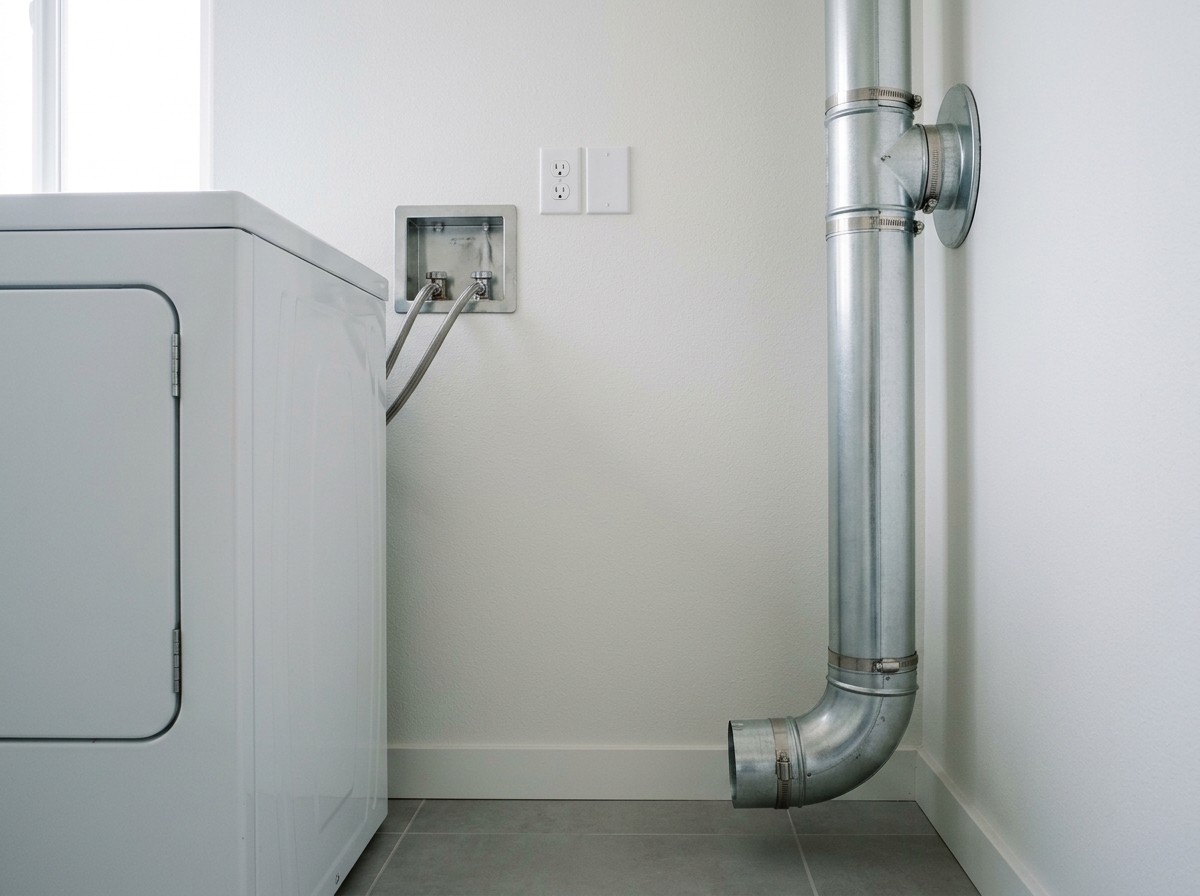
What electrical, vent, and rebate thresholds apply to dryer no-heat repairs?
Verify continuity specifications, IRC exhaust duct length deductions, and federal rebate caps before disassembling the rear bulkhead or ordering parts.
- Thermal Fuse Continuity
- 0 - 1.5 Ohms infinite = blown
- Dryer Element Coil
- 8 - 14 Ohms unplugged 240V
- IRC Duct Length Cap
- 35 ft equiv. -5 ft per 90 elbow
- DOE HEAR Rebate Cap
- $840 heat-pump dryer
Why does a tripped 240V half-breaker let the drum spin cold?
Residential electric dryers split 240V across two 120V hot legs: one leg drives the drum motor and timer while the second leg powers the heating coils.
- Toggle main 30A double-pole breaker OFF then ON: One tripped leg keeps drum lights and motor working while cutting 240V element power completely.
- Measure disconnected thermal fuse (0 - 1.5 Ohms): An infinite (OL) reading confirms overheating tripped the one-shot thermal fuse because outside exhaust airflow fell too low.
- Gas dryer glow-without-ignition checks: If gas dryer igniter glows bright orange then clicks off repeatedly without lighting, worn gas valve solenoid coils usually need replacement.
Who should choose DIY diagnostics vs hiring a licensed specialist?
Balance low-cost fuse and element repairs against $840 heat-pump rebates and rigid metal vent upgrades. Compare statutory rules, regional BLS trade wages, and mechanical hazard boundaries carefully before commissioning repairs.
Dryer under 8 years old with clean drum bearings where lint clogged the exterior damper.
Avoid when: Jumpering out a blown thermal fuse or re-using flimsy white vinyl/foil flex hose.
Electric dryer over 7-8 years old with control board failure or restricted vent runs.
Avoid when: DIY gas valve or 240V live voltage testing if uncomfortable with power isolation.
What are the limitations of these technical reference tables?
CodeBench benchmark lists trace to U.S. government open datasets, eCFR standards, and state statutes as of 2026 and are not a substitute for active factory warranties, municipal permits, or commercial engineering stamps.
Who should NOT rely on this list
- Who should NOT rely on out-of-warranty benchmarks: owners inside a 1-year warranty or open recall should contact the manufacturer first.
- Not a substitute for licensed trade permits on 240V circuits, gas manifolds, sealed cooling loops, or torsion springs.
- Not an affiliated OEM service desk: CodeBench maintains independent verification records only.
Which option fits your situation?
- Safe DIY checks: Limit work to unplugged cleaning, coin traps, serial decoding, and low-voltage photo-eye alignment.
- High-energy or sealed components: Escalate R-600a lines, 240V relays, gas valves, and wound torsion springs to qualified pros.
Which diagnostic tools and state hubs connect to this topic?
Use the linked CodeBench datasets, model directories, and state wage/licensing hubs below to verify parts, labor benchmarks, and municipal contractor registries.
FAQ
Clear answers to 2 common repair, safety, cost, and licensing questions backed by official government records and manufacturer manuals.
How much does it cost for someone to fix a dryer?
Dryer no-heat and squealing-drum repairs are among the most affordable home appliance fixes because heating elements (8 to 14 Ohms), thermal fuses (0 to 1.5 Ohms), idler pulleys, and drum rollers are modular and accessible. Labor aligns with Appliance Repair ($23.35/hr U.S. median) plus any IRC M1502 vent duct cleaning.
How much does it cost to get someone to fix a dryer?
First test the exterior wall hood for airflow: a lint-clogged exhaust vent blows out thermal fuses repeatedly, turning a straightforward thermistor or element swap into a repeat repair. Always inspect flexible foil transitions and clean rigid 4-inch metal ducting under IRC M1502.4.5.
Related guides
Sources
- International Residential Code (IRC) Section M1502.4.5 - Dryer Exhaust Ducts — International Code Council (ICC), IRC 2021 / 2024 (retrieved 2026-11-23)
- Clothes Dryer & Electrical Fires in Residential Buildings — U.S. Fire Administration (USFA / FEMA), USFA NFIRS Summary (retrieved 2026-11-23)
- Home Energy Rebates (HEAR) Program Specifications — U.S. Department of Energy (DOE), 2026 (retrieved 2026-11-23)
- OEM Service & Owner Manuals (GE, Whirlpool, LG, Samsung, Frigidaire, Bosch, Speed Queen, LiftMaster, Chamberlain, Genie, Wayne Dalton, Schlage, Kwikset) — Respective Equipment Manufacturers, 2020-2026 OEM Technical Publications (retrieved 2026-11-23)